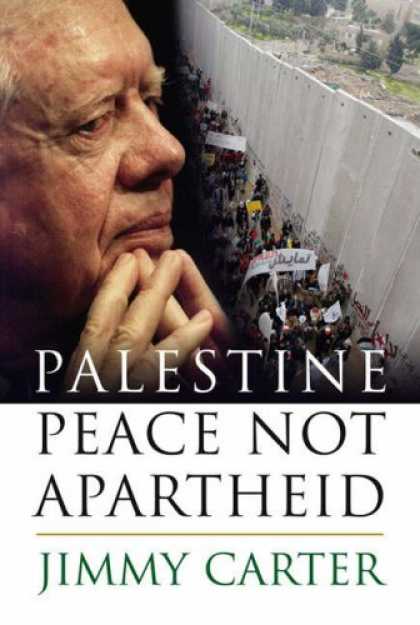
Since 2006, when former US President Jimmy (Dhimmi?) Carter published the most factually accurate book since the Protocols of the Elders of Zion, there has been a continued slander of Israel comparing it to the Apartheid of South Africa.
At long last the issue has been settled. There is a small segment of Israeli society in favour of Apartheid and has been outraged at a plan to increase integration of Arabs and Jews.
In last week’s Haaretz, an article was published entitled “Israel paving road to link East Jerusalem neighborhoods to city center”. And this was followed by the subheading: “New route would link northeast neighborhoods to capital's [sic] main Begin Boulevard; Peace Now: Plan is illegal use of occupied land, endangers two-state solution.”
Now barring for the moment that it is not illegally occupied by Jews, and neither is there a chance of any solution, let alone a two-state solution, let’s go along with Peace Now’s assertions...
If we’re to understand correctly, the extreme leftist Peace Now NGO believes that because, at some point in the future, east and central Jerusalem will be part of two different nations, that there shouldn’t be roads linking them?
This notion is an absurd one. If anything, roads help peace. They are means of communication (ask the Romans). But let’s turn this around for a moment. What if Israel were to demolish all roads out of Gaza; would Peace Now approve of this?
The article continues “Peace Now representatives argue that the "road's current route isn't legal, since the plan designates occupied territory for permanent infrastructures for the occupying power, while completely disregarding the needs of the Palestinian residents in Beit Hanina and the area."”
This is interesting! This is the first time I’ve ever heard that an allegedly undeveloped area would suffer because of increased methods of transportation to more prosperous and industrious areas. Links which could provide more business and trade, a link tourists could easily use (provided the Arab occupiers in Judea & Samaria stop attacking and killing strangers and the non-Muslim indigenous inhabitants).
The real reason the far left doesn’t want these roads built is the same reason the PA dictatorship doesn’t want these roads: to keep the conflict alive. And the main way to do that is via control of (Arab) public opinion1.
With all the Nazi-style propaganda broadcast by the PA-controlled media, Mahmud Abbas keeps power by doing what the surrounding Arab dictators want. And that is to keep this fictitious ‘Palestinian’ people fighting and killing Jews. The state of Jordan, which denies these Arab refugees their basic human rights (by not absorbing them as Israel absorbed the 850,000 Jewish refugees ethnically cleansed from Arab lands in 1948), keep the conflict alive.
The thinking behind this "evil Zionist road colonisation" project is that if these ‘Palestinians’ gain access to an easy method of transportation to central Jerusalem (especially from the West Bank), they will come to see the propaganda that they’re fed on a daily basis as wrong, and that Jews and Christians can be trading/business partners, and possibly even human.
This is my best guess. Of course there are major cultural obstacles to such a positive outcome (such as jihad; and killing Jews tends to annoy them, for some reason), and considering that genocidal, slave-capturing Muslims first gained access to Africa via Arab tradesmen (who became useful spies when planning their attacks), one wonders in this instance who has the better idea!, the left or right?!
Back in April, I talked about what the Hamas-Fatah coalition deal meant, that essentially Fatah (led by Mahmoud Abbas) had gone to Iran. What was not evident at the time, however, was the strategy Iran had for the territory Abbas presided over.
At the time, the move seemed strange and only advantageous to one side: why would Iran need such a strategically weak partner like Mahmoud Abbas when it's other proxy forces surrounded Israel (in Lebanon and Gaza)? Only now with the headline 'Hamas is against the PA Statehood Bid' have things begun to fall into place.
Hamas flags and portraits of Mahmoud Abbas being waved at the same rally
What has become evident is that the PA's bid at the UN is a last ditch effort to salvage Mahmoud Abbas' PA and 'his' territory from the clutches of Iranian control. Over the last several months we've been reading news such as Hamas flags going up all over the West Bank. While this might seem normal if both factions are in a unity deal, what was clear was that no portraits of Mahmoud Abbas were going up in Hamas-controlled Gaza.
In other words, the Hamas-Fatah unity deal was Mahmoud Abbas' 'death sentence'. Once Abbas had accepted the partnership, he effectively ceded control to Tehran. All Tehran had to do then was sit back and wait for the international community to distance itself from the coalition, thus leaving the PA vulnerable to the influence of Tehran, via Hamas.
With Abbas and his PA isolated, all Iran had to do was to was give Hamas free reign to start spreading its influence in the West Bank, thus not in fact making Abbas stronger, but weaker and more isolated than ever before.
The other side of this power struggle is, of course, the strategic importance of the West Bank. For Hamas, or any other anti-Israel force, having a presence in the West Bank means having 70% of Israel's population centre within short range rocket fire. And even though Hamas and Hezbollah both have rockets that can reach the Israeli population centres from Gaza and southern Lebanon respectively, with Israel's Iron Dome technology largely successful at intercepting rockets, having one more front from which Israel's enemies could harass her would be crucial given the terrorist's reliance on the psychological aspect of their war.
Additionally, it would be less likely that Israel attack Iran if its resources are tied up closer to home.
So Mahmoud Abbas' attempts to have a state recognised will be key in strengthening his hold on power. This will mean that Tehran will be forced to include Abbas in any of its plans.
But as we've been hearing, the US has announced it will veto any statehood bid, thus meaning a Palestinian state is not likely to be created and the US Congress will likely attempt to withdraw funding to the PA. So while this is risky territory for Abbas, we should note that there have been other patrons of the Palestinians, such as the Saudis, most notably during the 2nd intifada. And sure enough, the Saudis have stepped up to attempt to rescue the PA.
Once the statehood vote fails at the Security Council, it is then that the case will move to the UN General Assembly, in which the PA would not be susceptible to a US veto, thus be granted observer status. As we're told this will mean the PA will then have access to other UN bodies such as the International Criminal Court (ICC).
If the continuing fracas over the Goldstone Report is anything to go by, the Israel-Palestine war will likely graduate to a whole new level, and coupled with the international campaign to boycott, divest and sanction Israel (the BDS movement), having arrest warrants from the ICC against Israeli diplomats will serve as one of the biggest propaganda coups in the Muslim world's campaign to excuse terrorism and violence, as well as Islamisation of the West (citing, of course, the West's support for a 'war criminal' Jewish state). And this will be regardless of whether the cases against Israeli officials will have merit or not, as we saw with the recently overturned law in the UK called Universal Jurisdiction.
...and if anyone thinks that the ICC is a legitimate institution, devoid of the influence of the UN, they will be in for a rude awakening.
So if Mahmoud Abbas is able to achieve this reasonable sounding goal, this will not only mean him firmly placing himself at the centre of the 'Palestinian struggle', the Arab and Muslim world will reward him, thus cementing his hold on power. What exactly Abbas, or Tehran (for that matter), have in mind once this process is completed could be anything from the situation laid out above, and/or the continuation of the PLO Phased Plan devised in 1974.
In fact violence in the immediate term seems more than likely to be on the table (as a means to achieve their ultimate goals), with the usual excuses citing either failure at the UN for statehood, or some other pretext as we saw with the 2000 intifada, whether it was Ariel Sharon's visit to the Temple Mount (which was in fact carefully coordinatedwith the PA, not as the PA later claimed the 'provocative act which sparked the 2nd intifada), or the forgery that was the al-Dura Affair.
But this is only where we come to the much larger forces at play here in this complex story...
Quite interestingly, this sudden flurry of activity in the Middle East can be traced back to one single event in 2010. Barack Obama's UN General Assembley speech, when he stated that by September 2011 there would be a Palestinian State. What has occurred since then has been nothing short of amazing: WikiLeaks, PaliLeaks, the Arab Spring, the acceleration by Turkish PM, Tayyip Erdogan, of souring relations with Israel, and the announcement that colossal gas and oil reserves have been discovered off the coast of Israel; and the war in Libya under the UN doctrine of R2P (Responsibility 2 Protect).
Further to Turkey souring relations with Israel, Turkey's PM Tayyip Erdogan, is also vying to champion the Palestinian's cause as part of his increasingly bellicose statements regarding reviving the Ottoman empire.
So we have Iran, Turkey and Saudi Arabia, the old Middle Eastern enemies attempting to fight it out over a politically important piece of real estate. These are the 1400 year old rivalries of the Middle East, not only between sunni and shia, but between the more recent Wahabis and the Ottomans (who once controlled the Islamic holy cities of Mecca and Medina).
The Bigger Picture
So why are 3 of the biggest Islamic states fighting it out for control of such a small territory? Israel seems to be almost irrelevant in all this. We know that the Palestinian cause is very popular in the Arab and Muslim world. And we have seen in the past how the war with Israel has been used many times by terrorists or dictators to either distract a disgruntled population from uprising, or to manipulate a populous against a leadership, as we're seeing in Egypt and Jordan as the Muslim Brotherhood attempt to win support there, or with Erdogan attempting to rally support for his cause.
But even though the Palestinian cause has never been far away from Arab dictator sound bites, effective support on the ground has always been lacking. As we saw in Lebanon in 1982, these same dictatorships were happy to see Israel expel Yasser Arafat from Lebanon to Tunis. Compare that to the Saudis funding(with the CIA) to the mujahadin in Afghanistan against the Soviets in the same decade, which amounted to $1 billion.
Although Israel would be the icing on this particular Islamic cake, neither the Palestinian issue, nor the Israeli 'problem' are the main issue. The importance of this territory is in its political value. This is the reason the Muslim Brotherhood was founded: the re-establishment of the Caliphate, which was abolished during World War I and which Arabs today say they want to have situated at al-Aqsa Mosque in the heart of Jerusalem...
Having a Caliphate would be a significant game-changer in world affairs and history.
This is a video of one of the earliest radical Islamic groups, Hizb Ut-Tahrir, in a rally on the Temple Mount, Jerusalem (note the black flags, these are a declaration of war - jihad)
So the charge to be either the leader of the newly created Palestinian state, or patron of its cause, will have historic significance. This is the culmination of almost a century's worth of work, in what seems to be the next phase of a global quest by radical Islam for world hegemony, the central battle of which will be in the very heart of Israel.
"Senior Hamas official Mahmoud al-Zahar said Thursday that if the international community will recognize the Palestinian state as a member of the United Nation, the Palestinians will no longer be able to fight against Israel."
This is due to one aspect I did not cover in my piece: that regardless of whether 'Palestine' becomes a country or elevated to observer status in the General Assembly, the ICC requirements will also be placed on the Palestinians, not just Israel. Therefore Israel will also be able to bring the PA and Hamas before the ICC; a much more worrying prospect for Hamas. (David Benjamin at The Weekly Standard has more on this.)
As hopeful as this sounds, we cannot be too optimistic. Iran has sidelined Hamas in the past in favour of other, more difficult to trace terrorist groups to do its dirty work. Additionally, we have not seen any prosecutions of Iran, Pakistan, Saudi Arabia or even Iraq (under Saddam) for sponsoring Hezbollah, Hamas, al Qaeda, the Muslim Brotherhood, PLO (Palestine Liberation Organisation) etc.
The problems in these instances was not the law, but political interests interfering with the law (such as oil). And if the Palestinian state becomes an outpost of the Saudi oil giant, no need to guess what that will mean.
With the announcement that Hamas and the Palestinian Authority (PA) are to merge, calls in the US to ceasefunding the PA have begun to be addressed. However, what seems to have slipped everyone's attention in all this is the elephant in the room. The elephant that increasingly occupies much else in the Middle East...
The PA chairman, Mahmoud Abbas, cannot have failed to comprehend the US response to such a move. In the not too distant future, we are told that a Palestinian State is to be declared (most likely September). For years, Hamas - the Palestinian branch of the Muslim Brotherhood - has been at the throat of the more secular PA, after the PA refused to cede to Hamas in a landslide election defeat in the Palestinian territories in 2006.
Following the elections, a short but intense civil war broke out between the two factions in Gaza in which Hamas took control. Fatah, led by the PA maintained control of the West Bank. Fatah is the only 'non-terrorist' group declared in this rivalry, a position it has obtained due to its involvement in the fruitless Oslo Accords with Israel in 1993. However, Fatah's hold on power following the 2006 elections would seem to have made it an unlawful presence (much to the chagrin of the US and Israel). But the US and Israel were loathed to acknowledge this fact, not only because their horse, Fatah, had lost the elections, but due to the power and backing of Hamas, by Iran; the current Strong Horsein the region.
Following the declaration of a Palestinian State, it would not be hard to imagine that if the PA and Hamas were still rivals, a repeat of the violence we saw in 2006 would occur. But with the possible inclusion of more actors, including Hezbollah (via Syria), more extremist followers of the Muslim Brotherhood via Egypt (such as the ones in Gaza that killed the Italian activist Vittorio Arrigoni), and myriad other proxy militia, all against the PA, the PA would stand no chance.
So this unity coalition move by the PA not only means avoiding such an acrimonious fight, but also means the PA's leader, Mahmoud Abbas, maintains a hold on power, even though it will be somewhat less than he has now. And the threat to cease funding the PA? The tab will be picked up by Iran. As the widely publicised 3rd intifada nears (May 15th), it would be hardly possible for the PA to engage in open warfare with Israel, without having its patron (the US) kick up a serious fuss. This move then, is simply the PA changing patrons, although this transition of power is likely to be done quietly.
Such moves by the PA serve to only further the claim that Israel is the US's only true ally in the region. We can see that after years of the US attempting to bring both sides in the Israel-Palestine conflict together, Mahmoud Abbas has seemingly done a 180 degree u-turn and placed his vote with a country that has vowed to 'wipe Israel off the map'.
Update: It seems I wasn't the only one to spot this shift of Mahmoud Abbas to Iran. Over at CIC, Stephen McDonald arrived at the same conclusions:
"Iran has endorsed the Hamas-Fatah marriage. This despite claims by some that a unity agreement offers an opportunity for Hamas to be separated from its attachment to Iran. The logic being, when pulled out of isolation with the West, Hamas will no longer need the support of its paymasters in Tehran.
What evidence is there to support such a noble belief? The facts indicate precisely the opposite."
In my last post, I showed Iran's tactical game play in the Mid East, particularly with regards to Israel. But supposing the Iranian Navy were able to enter the Red Sea, what then?
There are no numbers yet, but several reports cite Muslim Brotherhood (MB) activists among the protesters. With the uprisings intensifying this Friday just gone, the involvement of the mosques seems all the more plausible.
But so what. So what if the MB takes power and gains a significant power-sharing position in any future government. There is a possibility that it would respect peace accords with Israel, with the benefit of reaping US aid (reportedly in the region of $1.5 billion annually). But that's not what we saw from Hamas, the Palestinian branch of the Muslim Brotherhood.
Of course, Hamas are in the pockets of the Iranians. They were not reliant on US aid for their survival. But US aid isn't the only thing Egypt has.
The quotation at the outset of this post is from a book written in 1899. While Egypt's greatest resource might no longer be the Nile, substitute the word 'Nile', with 'Suez' and you might be getting onto the right track.
In 1956 and '67, wars between Egypt and Israel were fought over the Suez Canal; a vital shipping artery for oil to Europe and the US. But even more than this, Egypt also possesses unique geographical relations to Saudi Arabia, and borders Sudan and Libya (all 3 countries with oil). But not only this, if we're to believe the reports that the Muslim Brotherhood is taking advantage of the recent coup in Tunisia (which neighbours Libya from its other side), and considering Iran has been funding insurgents in Yemen (to the south of Saudi Arabia), this makes Egypt prime real estate, enveloping two countries (Libya and Saudi Arabia) which means killing more than two birds with one stone.
So, would Iran attempt to take over the Suez Canal, especially considering Israel's decisive wins in both conflicts?
Iran wouldn't need to be in control of the Suez, in order to wreck havoc and affect oil prices. Iran has invested in remote controlled, naval warfare vessels (speed boats) which could easily attack oil-tankers.
"IRNA said Zolfaqar was a new generation missile-launching vessel which can be used for patrol as well as for attack operations.
"It is designed for quick assaults on ships and is equipped with two missile launchers, two machine guns and a computer system to control the missiles," the report said."
When looking at the history of conflicts between Israel and Egypt, they have always been in Israel's favour. But not so with Iran-backed Hezbollah. In 2006 Israel fought a disastrous campaign against Hezbollah, in which Israel attempted to quash Hezbollah almost exclusively from the air. While Hezbollah is not a traditional army fighting to hold, or take, a specific territory, it nevertheless managed to entice the Israelis to overwhelm Hezbollah with sheer power. An act that resulted in Israel's munition supplies being depleted after only one month. And when looking at Israel and Hezbollah's encounter before this, the Lebanon War, it lasted from 1982-2000. A full eighteen years of conflict.But Israel has now improved its military once more, thanks to chief of staff Gabi Ashkenazi, and these encounters with Hezbollah have become hard lessons.
This just goes to show Iran seems to be hoping to extend this method of warfare to other regions. To digress briefly, these are classic tactics based on Sun Tzu's The Art of War. A three thousand year old text from China about all things strategic. How Islamists got a hold of this is more than likely during the Cold War, when the Communists backed various Arab regimes.
But there are several other examples of how Iran has successfully employed asymmetrical warfare, and against a rival even more powerful than Israel, the US.
In Iraq, Iran funded rival Sunni and Shia insurgents, not only for the purposes of keeping the US bogged downin conflict, but as a psychological tactic to demoralise US public opinion back home. Something the left in the US has only been too willing to oblige.
In Nigeria, Iran has been happy to help fund jihadists there. So Iran has no problem funding Sunnis, it doesn't even have issues supporting and training non-Muslims how to fight. If it serves their purposes. As Sun Tzu says, war is an extension of policy. The best way to get what you want is not to even lift a finger; let someone else do it for you. This we saw in Vietnam, in Afghanistan against the Soviets and in the war on terror.
So to return to our original premise, Iran doesn't need to posses the Suez Canal, should the US or its allies allow Iran to reach it, nor does it need to posses Egypt, in the traditional sense. As long as it fuels chaos from there and creates instability, it is only a matter of waiting while it bides its time, waiting for others to wear themselves down.
With regards to Israel, it is considerably more restrained after having been impeded from pursuing its aims with Iran by the Obama administration. Israel has to contend with Hezbollah, Syria and possibly Turkey in the north; Hamas in Gaza, and potential uprisings to Israel's East (West Bank, Jordan). Lastly, it seems from within, Israel's left are attempting to coordinate uprisings from Israel's Arab community, as they have done for well over a decade.
Israel's current leadership is more competent than any other having served within the last few decades. It has seen many intifadas and peace processes, and in the last few months Benjamin Netanyahu has shown himself to be particularly adept at negotiating more time with Obama's suicidal peace policies. What Israel must be aware of now, is not rushing into provocations, nor attempt to win wars with overwhelming force, especially when it has to consider Barak Obama's indolence where Iran is concerned.
The next few hours will be crucial...
Update 1/31/11: "Egyptian intelligence chief and newly [July 2009] appointed Vice President Omar Soliman told then-Central Command commander Gen. David Petraeus, “’we hope Iran will stop supporting Hamas, the Muslim Brotherhood and other cells’ within Egypt … ‘but if not we are ready.’”" Washington Times
Update 2/4/2011: Shippers concerned over Suez Canal vulnerability
Update 16/2/2011: Classic Sun Tzu ambush, taking things in a new direction: Iranian Warships in Med A Serious Provocation say Israel


 with the PA, not as the PA later claimed the 'provocative act which sparked the 2nd intifada), or the forgery that was the
  (with the CIA) to the mujahadin in Afghanistan against the Soviets in the same decade, which amounted to $1 billion.
 in the region.


 But Israel has now improved its military once more, thanks to chief of staff Gabi Ashkenazi, and these encounters with Hezbollah have become hard lessons.
 in conflict, but as a psychological tactic to demoralise US public opinion back home. Something the
